Category: Synaptic Package Manager (Page 2 of 2)

Partial Upgrades in Ubuntu + Docky issue [FIXED]

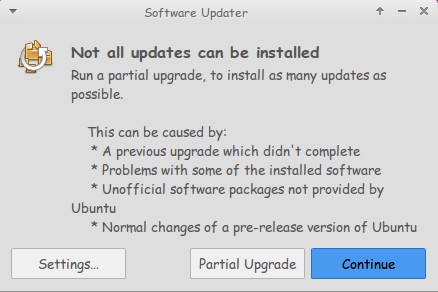
One day out of the blue Ubuntu said it needed a partial upgrade, I clicked OK and didn’t think twice about it, it did some work on many packages and for some reason Docky 3.0 (Experimental branch by Rictoz) was selected for “upgrade” and after the reboot it was gone!
The partial upgrade in general is nothing to worry about and it’s safe to click continue, especially I’m running Ubuntu  14.04 LTS which is supposedly supported until late 2019.
I was set back to Docky 2.0.2 which I don’t have a problem with, except it crashes.

(If you read my Docky post you know that I chose Docky 3.0 over 2.0.2 because it’s more stable and doesn’t crash randomly all the time. Despite Docky 2.0.2 having cool “Docklets” that added to it’s functionality.)

I couldn’t install Docky 3.0 due to package dependency issues, and therefore I was stuck with Docky 2.0.2 for a while, only then I realized how much I depended on it to get my things done!

The fix was super easy!

I went to the downloaded files I had which were three files: Docky, Libplank, and Libplank common.

Using Gdebi I installed Libplank common the first, then Libplank and finally Docky 3.0, it replaces the old one and no need to uninstall.

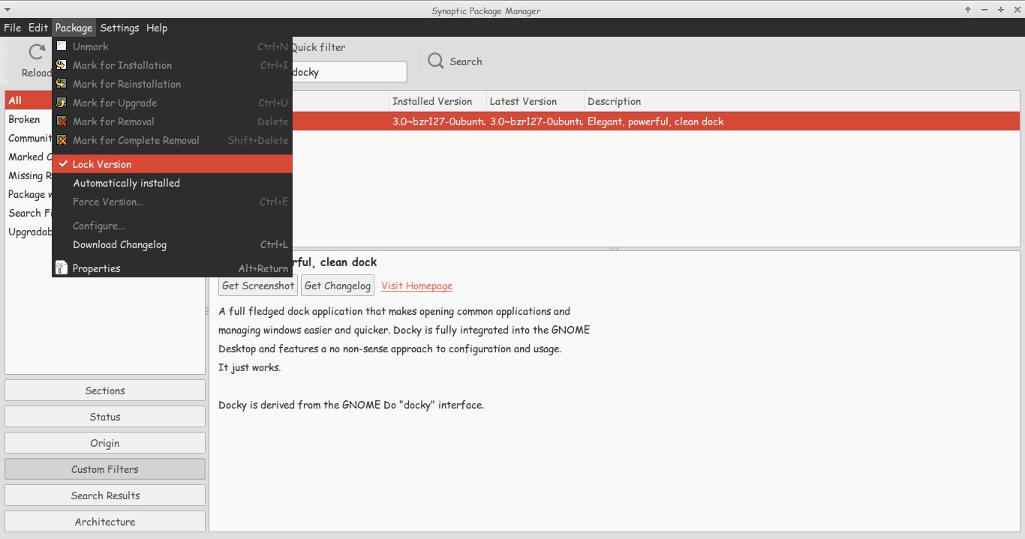
Thing is every time it looks for updates it wants to remove Docky, and that happens daily, I found a way to fix that by simply “locking” the version.

I went to Synaptic and searched for Docky, selected it and clicked lock version under package. Now even when it looks for updates it greys out Docky and doesn’t update it. I have a detailed tutorial on how to use Synaptic that you can find here.
That’s how I got Docky 3.0 back after it was ruined by the partial upgrade, I hope you found this useful, please let me hear your feedback and have a nice day.

Batch install downloaded DEB packages on Ubuntu

Today’s post is a re-write of “How to add downloaded packages to Synaptic Package Manager in Ubuntu 13.04” because I had to install packages Offline when I was fixing my brother’s computer. And something wasn’t right!

In that particular case I installed Ubuntu 14.04 twice in the same week so using the same packages to update was probably the right thing to do to save time and data plan.

Anyway based on my recent experience it will be much more clear. And I added pictures too! Synaptic is a GTK+-based graphical user interface for Advanced Packaging Tool (APT)—the Package management system used by Debian and its derivatives. Synaptic is usually used on systems based on deb packages but can also be used on systems based on RPM packages. (Source)

We are using it today to batch install software on Ubuntu, and you must take note that it’s a powerful tool and can potentially harm your system. So take care. You are going to need admin permission to access Synaptic.

Also don’t install anything you don’t trust! Be careful because now the program has admin permission to change your system!


After we took a look at the warnings, let’s take a look at the scenarios:
You are an Ubuntu admin and you have 10+ computers. And you need to install the same software on all 10 computers. So instead of Connecting them all to the Internet and downloading the same software. Connect one of them and download the required software. Then install it on the rest.

You just installed Ubuntu on a machine and begun to download software. But the Internet is really slow! (Third world problems) so you take the programs on a USB from another computer and get to work!
You have a limited data plan and you are trying to save!

No matter what was the situation. It’s a handy trick and you will comeback to this tutorial over and over to read it!

First of all. Let’s prepare the software.

You can either use the software center cache. Or any random .deb packages you have. (Or both)

If you want to copy the software center cache then go to the directory:

“Computer/var/cache/apt/archives” where “computer” is your system partition.

This is a system folder so you can’t cut or delete any of these packages. And if you copy the .lock file or the partial it will result in copy error.

Remember where you put the packages and the folder name as we are going to need that later.

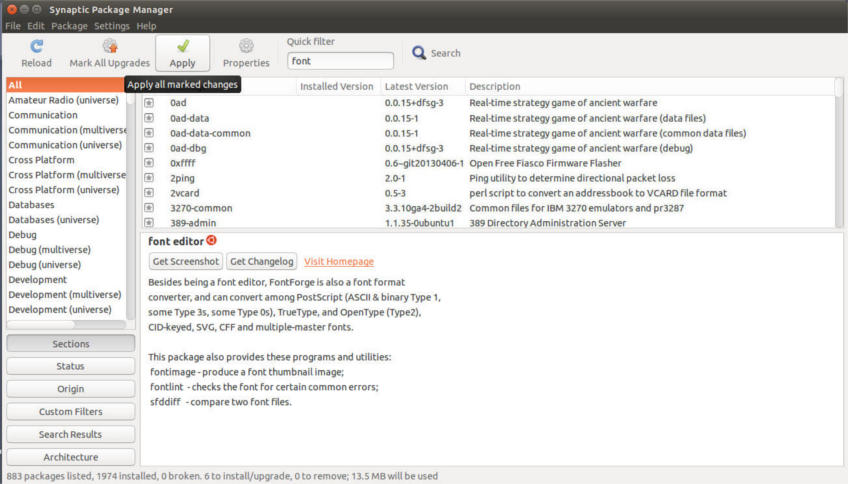
Open Synaptic and enter your password. If you don’t have Synaptic you have to install it. Say from the Ubuntu Software Center.


Once you opened it you have to confirm that you are online. I can’t stress this enough. And it won’t work if you aren’t connected to the Internet.

You can confirm that by reloading package information. If it downloads package information without problem. Then you are good to go!


Paste all the packages in that directory, in this tutorial it’s called “New Packages”.

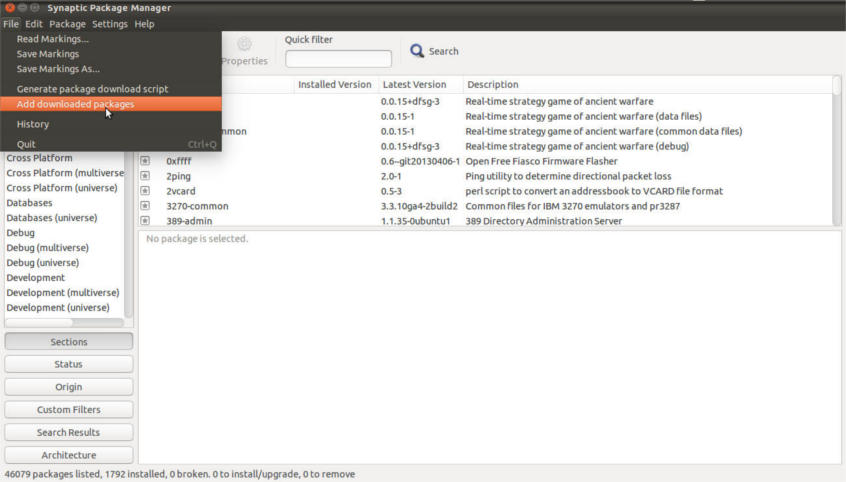
Click file Add downloaded packages.


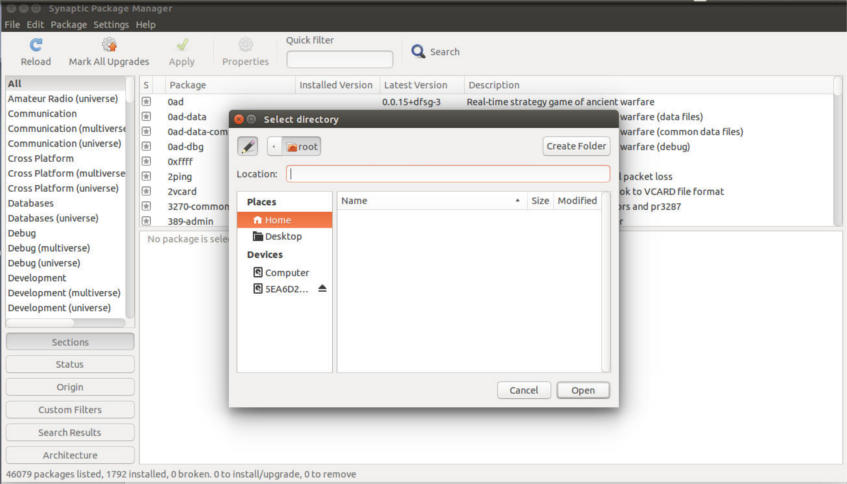
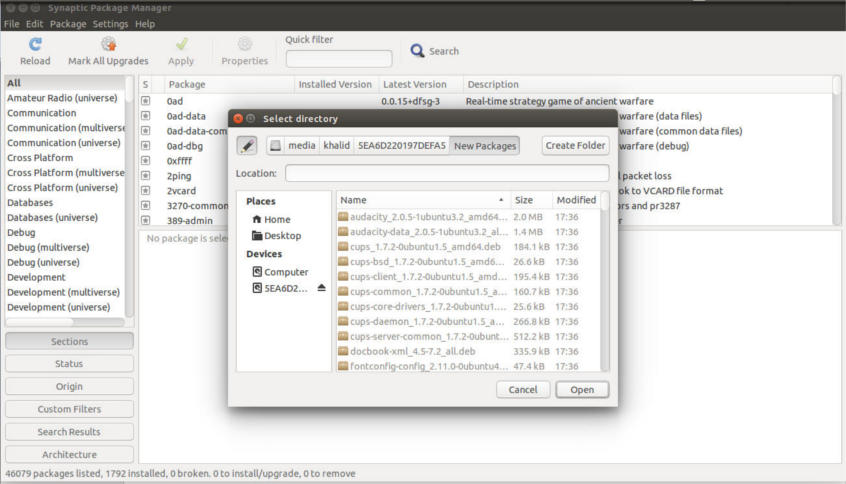
You will see a browse dialog., use it to navigate to your folder.

once there click open.


Wait a moment for the packages to add. It can take several minutes when adding a lot of packages.

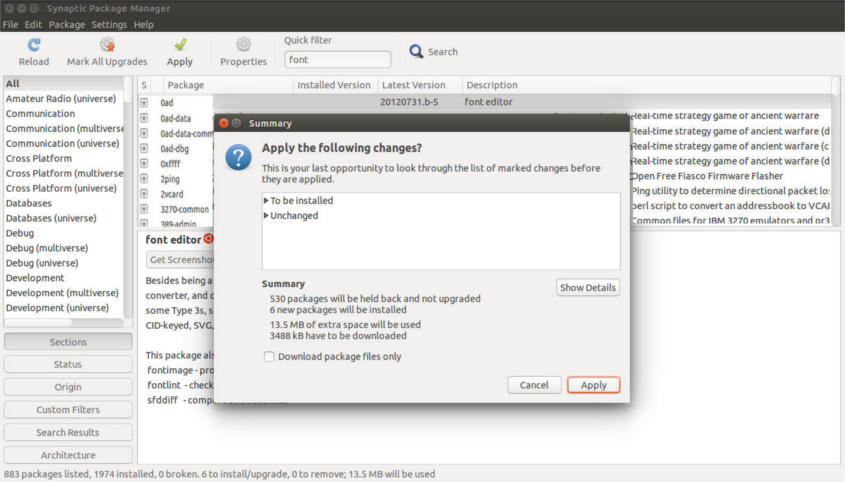
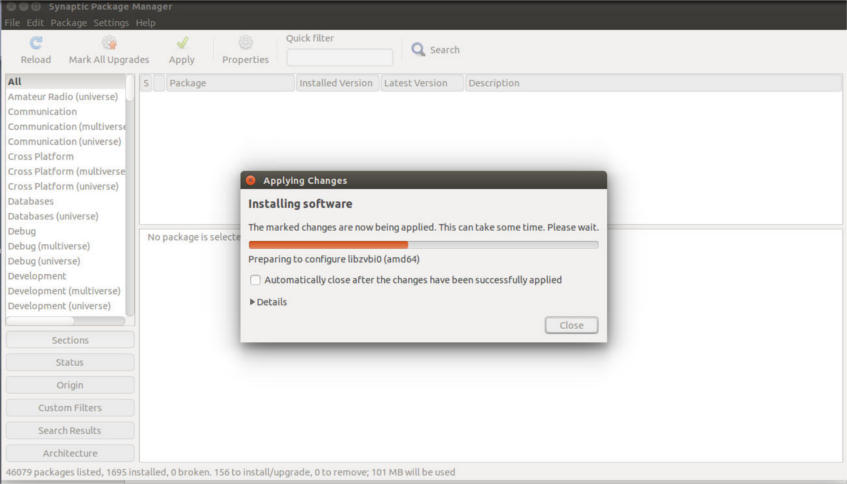
Click Apply and Synaptic will tell you how much packages will be installed. The size of install and how much it will download.

Wait for the progress bar to end.


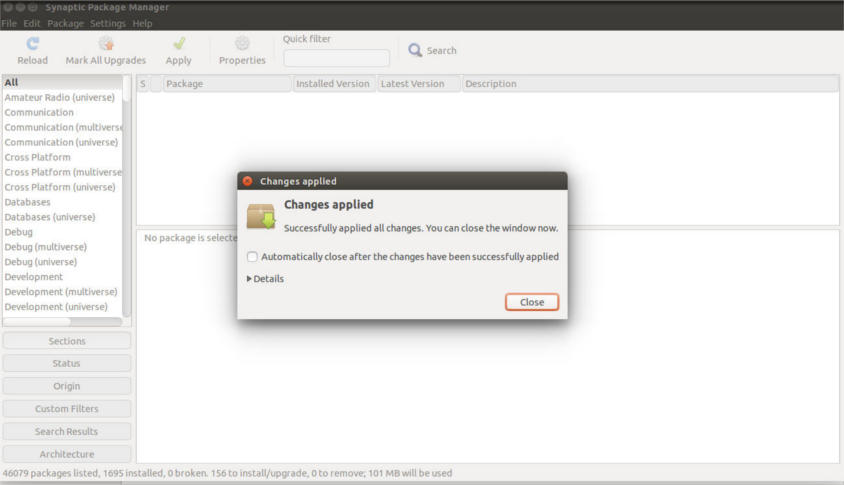
Then click close to finish installing the software.

This way we installed a batch of software as we would install a single one. Without re-downloading them again!

Pretty handy isn’t it?

How to add downloaded packages to Synaptic Package Manager in Ubuntu 13.04

Hi, good day to you

There are several ways to install software in Ubuntu, some are easy like the Software Center, and are a bit advanced like Synaptic Package Manager, and you can download a DEB file form the Internet and install it (not recommended)..


But what happens when you want to transfer a lot of software to another computer, or install them on your freshly installed Ubuntu?

You can download them one by one of course :/ but you don’t want to do that, don’t you?
That’s why you are here 😉

My way is very simple and requires a little knowledge of your system.

  •  First copy the software you need from this directory on your computer:
    “/var/cache/apt/archives”
  • Copy the ones you need or all of them if you like
  • Paste them in a folder in your system partition (Where Ubuntu is installed), like your home folder.
  • Now open Synaptic Package Manager and enter your administrator password.
  • When it loads up navigate to File Add downloaded packages
  • Browse to the folder Archives you just copied form the old computer
  • Wait for it to add the packages, and here you have them.
  • It will install the changes automatically (Batch install your packages). 

As easy as that 😀

And the sweet part is: If you previously backed up your computer and restored it after adding the packages you will restore the settings as well 😀

Here you have it 😀 I hope you find this useful  🙂
P.S: I tested it on Zorin OS 7, so it should work on Ubuntu 13.04 with no problem.
If you like it please recommend it on Google + and subscribe to my blog
Have a nice day <3

Newer posts »